


I’ve always been fascinated by how our bodies carry hidden stories—our height, for example, isn’t just about how tall we stand. It’s about what we’ve stood through. Nutrition, regional culture, parental health, economics, even access to toilets. Sounds strange? Yeah, it surprised me too. But the deeper I dug into Indian height data over the years, the clearer it became—height in India is more than a number. It’s a mirror reflecting the country’s layered complexity.
Key Takeaways (From My Notebook to Yours)
- Indian men average around 5 ft 5 in (165 cm). Women: about 5 ft (152 cm).
- Urban folks are generally taller than rural populations, due to better access to nutrition and healthcare.
- Punjab and Kerala lead the height charts. Odisha and West Bengal usually fall behind.
- Gender gap in height hovers around 13–14 cm, fairly consistent across decades.
- Children are growing taller, but India still lags behind global child height standards.
- Height has increased slowly post-independence, but not as much as one might expect.
- The biggest growth drivers? Maternal health, childhood nutrition, and basic sanitation.
Average Height of Indian Men and Women
Let me start with the big numbers—the ones everyone googles first.
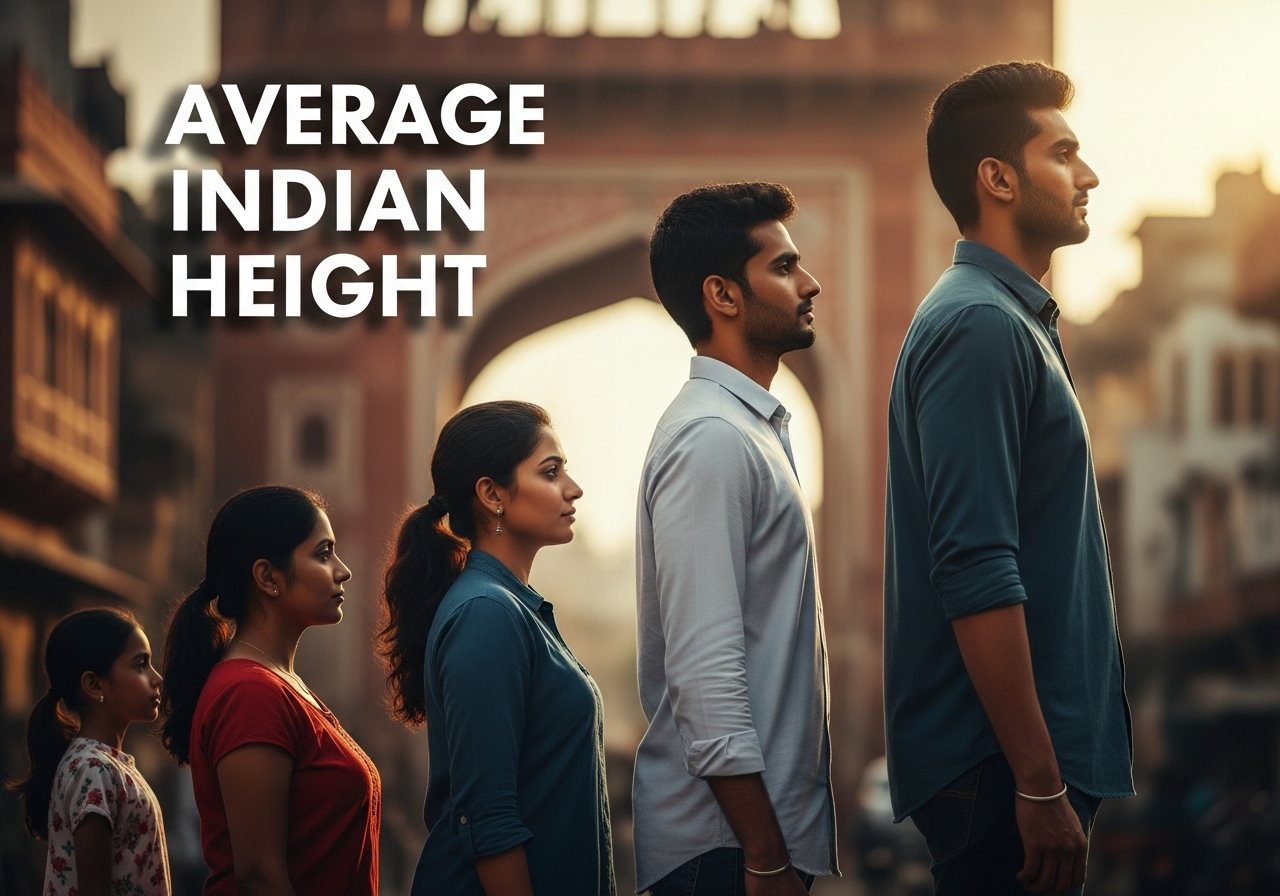
As per the NFHS-5 (2019–21) data, the average Indian man stands at about 165 cm, while the average woman is around 152 cm. That’s remained fairly stable in recent years, with minor upticks that are more noticeable in urban samples.
What stood out to me wasn’t just the static numbers, but how the “height average gap” between genders has stayed almost constant—roughly 13–14 cm—over the last three decades. It didn’t matter whether I was looking at WHO growth references or digging through ICMR reports.
What’s strange though is how this average can feel misleading. I mean, I’ve stood in Delhi metro coaches where most men tower at 5’9″, and then taken buses in rural Bihar where I’m among the tallest—and I’m just 5’7″ myself. The variability is real, and we’ll get to that.
🧠 Data check: According to WHO and ICMR reports, adult Indian male height increased by ~1.1 cm from 1998 to 2020. For women, the change was ~0.9 cm. That’s modest growth.
Historical Trends in Indian Height
I always assumed we were growing taller generation by generation. Turns out, it’s not that linear.
After India’s independence, height data slowly started trickling in. Over the decades, height did improve, but not dramatically. According to World Bank and UNDP-backed studies, the average height has increased by just 3–4 cm over the last 60–70 years.
The term for this slow generational shift? It’s called the “secular trend” in height. And India’s trend has been… well, secular but sluggish.
One major reason is the persistent stunting rate in childhood. What I’ve found is that chronic undernutrition in early years—especially the first 1,000 days—casts a long shadow on adult height. Even if you feed a teen well later on, the early deficit doesn’t fully reverse. That’s a hard truth.
Regional Differences Across India
Now, this part really blew my mind.
Why are Punjabi men often around 5’8″, while Odisha men average closer to 5’4″? It’s not just food, though dairy-heavy diets in Punjab and Kerala do help. It’s genetics, climate, and socio-cultural structures, too.
Let me give you a quick comparison table from NFHS data and regional surveys:
| State | Avg Male Height (cm) | Avg Female Height (cm) |
|---|---|---|
| Punjab | 169 | 156 |
| Kerala | 167 | 155 |
| Maharashtra | 165 | 152 |
| West Bengal | 163 | 150 |
| Odisha | 162 | 149 |
My take? Kerala’s consistent access to healthcare and education has quietly boosted average stature. Punjab’s protein-rich diet and agricultural lifestyle play their role. Meanwhile, places with lower income and sanitation infrastructure see height suffer.
Urban vs Rural Height Differences
Here’s something I’ve noticed personally, and the data backs it up: urban kids tend to shoot up taller than rural kids—by as much as 2–3 cm on average.
It’s not magic. It’s access.
Cities offer better sanitation, hospitals, midday meal programs, and even basic things like clean water. Rural areas, despite recent efforts under Swachh Bharat and POSHAN Abhiyaan, still lag—especially when it comes to nutrition diversity and hygiene.
This is what researchers call the “urban nutrition gap”. I saw this firsthand in Rajasthan during a field project. Kids from even lower-middle-class families in Jaipur looked visibly taller and healthier than kids from just 30 km outside the city.
Average Height of Indian Children
Now, if you want to know where India stands globally—this is the litmus test.
India’s average height-for-age z-score (HAZ) for kids is still below the global median, according to WHO growth standards. The recent NFHS-5 data showed that stunting affects 35.5% of Indian children under 5. That’s down from 38.4% in NFHS-4—but still shockingly high.
Programs like ICDS and the Mid-Day Meal Scheme have helped. But in my opinion, they’re just not reaching deep enough into the critical years—especially pre-school age, when growth velocity peaks.
So, yes, Indian children are growing taller, but they still face a structural disadvantage compared to children from even neighboring countries like Sri Lanka and Bangladesh.
Factors Influencing Height in India
When people ask me, “What affects how tall someone grows in India?” I tend to say: birth lottery + diet + toilets. Let me explain.
- Genetics does matter, of course. But it sets a range, not a destiny.
- Nutrition—especially proteins, iron, zinc, and Vitamin A—has massive impact. And that’s where many Indian diets fall short.
- Sanitation plays a weirdly big role. Repeated childhood infections due to poor hygiene stunt growth. That’s part of why Swachh Bharat mattered.
- Maternal health, prenatal care, and epigenetic effects (how genes express themselves based on early environment) are huge but underrated.
According to the National Nutrition Mission, malnutrition—especially protein-energy malnutrition—remains one of the leading causes behind India’s short average stature.
Height and Socioeconomic Indicators
There’s no polite way to put this—the poorer you are, the shorter you’re likely to be in India.
The NSSO and SECC 2011 data show a clear correlation between income levels, educational attainment, and child growth patterns. In lower-income households, where food security is inconsistent and healthcare is patchy, children often fall off the growth curve early.
But it’s not just about income. Caste, education level of parents (especially mothers), and even geographic access to schools and toilets factor in. This is what researchers sometimes call “height equity” or its absence.
What really strikes me is how height becomes a physical indicator of social development—like a walking bar graph.
How India Compares Globally
Brace yourself. Globally, India ranks well below average in height.
Let me put this in numbers:
- Dutch men average 183 cm. Indian men? 165 cm.
- South Korean women average around 162 cm. Indian women? 152 cm.
Even compared to our South Asian neighbors, we’re not leading:
- Bangladeshi men: ~167 cm
- Sri Lankan men: ~168 cm
- Indian men: ~165 cm
Sources like the Global Nutrition Report, WHO, and UNDP consistently highlight India’s position as needing improvement on child nutrition and adult anthropometric benchmarks.
But again, context matters. India’s massive population, regional disparities, and deeply unequal development trajectory make this more than a simple nutrition problem.
Final Thoughts (A Bit Unfinished, Like Growth Itself)
If I’ve learned anything from years of diving into height data, it’s this: India isn’t short because of one problem. It’s short because of many small ones stacking up—over years, across generations.
I used to think getting taller was just about milk and exercise. Turns out, it’s about mothers getting enough prenatal care, toilets being built in villages, protein access in school meals, and genetics doing what they can in the margins.
Growth, in India, is slow. Sometimes frustratingly so. But it’s happening. Quietly. Inch by inch.
Sources & References
- NFHS-5 Full Report (2019–21)
- World Bank Data on Anthropometric Indicators
- Global Nutrition Report – India Profile
Want to dig deeper into how height growth connects to fitness, sleep, or daily routines? I’ve got more notes where this came from—but that’s a story for another day.