


Most parents, at some point, have wondered whether there’s a formula for it — the right combination of food, movement, and supplements that will help a child reach their full height. The short answer is that no such formula exists. But the longer answer is genuinely useful, and it’s what this article is for.
The “growth triangle” is a practical framework — not a medical term — for thinking about how exercise, nutrition, and supplementation interact during childhood and adolescence. Each side supports the others. None of them overrides genetics or biology.
The growth triangle describes how adequate nutrition, regular physical activity, and appropriate supplementation work together as lifestyle supports for normal human growth and development. No combination of these factors guarantees a specific height outcome, but together they help children reach the height their genetics allows — provided sleep, healthcare, and general health are also in place.
Key Takeaways
- Genetics accounts for roughly 60–80% of final adult height, according to research reviewed by the NIH. Lifestyle factors matter, but within limits set by biology.
- Adequate nutrition — particularly protein, calcium, vitamin D, and zinc — supports normal bone development. Deficiencies can interfere with growth; surpluses don’t produce extra inches.
- Weight-bearing and impact exercise supports bone density and musculoskeletal health. It does not mechanically lengthen bones.
- Supplements like NuBest belong in the framework as a potential dietary gap-filler, not as the centerpiece. Food comes first.
- Sleep is the factor families most often underestimate. Growth hormone secretion peaks during slow-wave sleep, and consistently short nights work against everything else on this list.
Exercise, Nutrition, and NuBest: What Is the Growth Triangle?
Think of it as three sides of a triangle, each one necessary for the shape to hold. Nutrition provides the raw materials — amino acids, minerals, vitamins — that bone and muscle tissue need during development. Physical activity stimulates musculoskeletal adaptation, supports bone density, and keeps the body functioning as it should. Supplementation, when appropriate, addresses dietary gaps that whole foods haven’t covered.
The triangle is not a system for adding height. It’s a framework for making sure the body has what it needs to follow its natural developmental course.
Why the Three Components Should Be Viewed Together
Supplements cannot compensate for chronically poor nutrition or inadequate sleep — full stop. A child taking a daily multivitamin while skipping breakfast, sleeping six hours a night, and avoiding vegetables is not running a healthy growth routine. The supplement is doing very little work in that context.
The reverse is also worth saying: a child with excellent nutrition and consistent physical activity may not need supplementation at all. The triangle works when all three sides are present. It fails — or at least underperforms — when one side is treated as a substitute for the others.
Energy availability matters across all three. A teenager training hard for a sport while under-eating is not getting the full benefit of either the exercise or whatever nutrients they do consume. Bone remodeling and muscle recovery both require adequate caloric intake, not just the right micronutrients.
What Actually Determines Height and Physical Growth?
Genetics is the dominant factor. The NIH estimates that 60–80% of height variation across populations is heritable — meaning the single biggest predictor of how tall a child will be is how tall their parents are. This isn’t a reason to give up on lifestyle factors. It is a reason to have accurate expectations about what those factors can do.
Beyond genetics, the main biological drivers are: the timing and pace of puberty, growth hormone and IGF-1 secretion, the developmental stage of epiphyseal (growth) plates, overall health status, and nutritional adequacy during key developmental windows. Environmental factors — food access, disease burden, stress — influence whether a child reaches their genetic potential, which is not the same thing as exceeding it.
Short parents can still have tall children depending on how the full genetic inheritance plays out — height involves contributions from dozens of genes, not a simple average of parental stature.
Genetics vs. Modifiable Lifestyle Factors
Here’s the distinction that matters most: modifiable lifestyle factors support normal growth and development. They help a child reach their inherited potential. They don’t extend it.
A child with adequate protein, vitamin D, calcium, and regular physical activity who also sleeps 9–11 hours a night (the American Academy of Sleep Medicine recommendation for school-age children) is giving their body the conditions to develop normally. A child with chronic nutritional deficiency, sedentary habits, and poor sleep is working against their own biology — and lifestyle changes can genuinely help recover some of that lost ground.
The ceiling, though, is genetic. That’s not pessimism. It’s just how human growth works.
Nutrition: The Foundation for Normal Growth and Development
Adequate nutrition is what makes everything else possible. Bone tissue needs calcium and phosphorus as structural minerals. Growth hormone needs protein — specifically amino acids — to produce its effects on tissue. Vitamin D mediates calcium absorption in the gut. Without enough of any of these, normal skeletal development slows.
The good news for most American families is that a reasonably varied diet covers the basics. Milk or fortified plant-based alternatives, eggs, chicken, fish, beans, Greek yogurt, whole grains, leafy greens, and fruit — that’s not an exotic shopping list. It’s what USDA’s MyPlate framework has been recommending for years.
Protein, Calcium, Vitamin D, Zinc, and Other Nutrients
| Nutrient | Role in Development | Common Food Sources |
|---|---|---|
| Protein | Tissue building; supports IGF-1 production | Chicken, fish, eggs, beans, Greek yogurt |
| Calcium | Bone mineralization; structural support | Milk, fortified alternatives, cheese, broccoli |
| Vitamin D | Calcium absorption; bone health | Fatty fish, fortified milk, sunlight exposure |
| Zinc | Cell division; protein synthesis | Meat, shellfish, legumes, seeds |
| Magnesium | Bone structure; enzyme function | Nuts, whole grains, leafy greens |
The key word in that table is “role” — not “guarantee.” Calcium supports bone mineralization. It doesn’t instruct bones to grow longer. These nutrients create the conditions for normal skeletal development, particularly when intake is adequate relative to developmental needs.
Deficiency is where the real risk sits. A child with chronic vitamin D deficiency, for example, can develop rickets — a condition that directly impairs skeletal development. Correcting that deficiency with appropriate intake (and sun exposure) restores normal function. That’s a meaningful intervention. Giving extra vitamin D to a well-nourished child, though, doesn’t produce proportionally extra height.
Food First vs. Dietary Supplements
The food-first framework from the FDA and most registered dietitians is straightforward: whole foods provide nutrients in combinations that supplements can’t fully replicate, along with fiber, phytonutrients, and other components that matter for overall health.
Supplements make sense when dietary intake genuinely falls short — for kids on restricted diets, with specific health conditions, or with confirmed deficiencies identified by a healthcare provider. They’re also reasonable as an insurance policy when a family knows their child’s eating habits are unpredictable or limited.
What they’re not: a replacement for meals, a correction for consistently poor dietary habits, or a way to get nutrients that exceed the body’s ability to use them. Tolerable upper intake levels exist for a reason — nutrient excess isn’t neutral, and some fat-soluble vitamins accumulate to problematic concentrations.
Exercise: Supporting Strong Bones, Muscles, and Fitness
The CDC recommends that children and adolescents get at least 60 minutes of moderate-to-vigorous physical activity daily, including muscle-strengthening and bone-strengthening activities at least three days per week. That guidance exists because movement matters for healthy physical development — not because it makes children taller.
Weight-bearing and impact activities stimulate bone remodeling. Running, jumping, and sports that involve rapid direction changes — basketball, soccer, volleyball — place mechanical loads on the skeleton that signal bone-forming cells to increase density and structural strength. Does basketball make you taller? Not directly. But it does develop the musculoskeletal system in ways that matter for long-term bone health.
Which Types of Exercise Are Most Useful?
Not all movement serves the same purpose. A practical breakdown:
Bone-strengthening activities — running, jumping rope, gymnastics, basketball, volleyball — involve impact loading that stimulates bone density gains. These are particularly valuable during childhood and adolescence, when peak bone mass is being established.
Muscle-strengthening activities — bodyweight exercises, resistance bands, age-appropriate resistance training — build the muscle tissue that supports skeletal structure and protects joints. The concern that weight training stunts growth in children is not well-supported by current evidence, provided exercises use appropriate form, intensity, and supervision.
Aerobic activities — swimming, cycling, hiking, school sports — support cardiovascular fitness, metabolic health, and overall energy availability, which feeds back into everything else.
Swimming is worth singling out because it generates a common misconception. Swimming supports cardiovascular fitness and overall development, but it’s a low-impact activity — it doesn’t apply the bone-loading stimulus that higher-impact sports do. That’s not a reason to avoid it. It’s a reason not to rely on it exclusively if bone-strengthening activity is the goal.
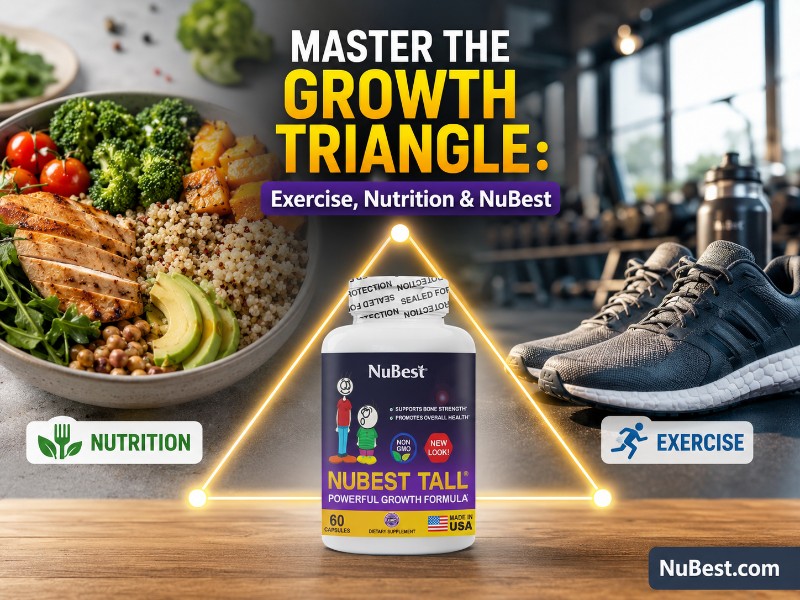
NuBest: Where Supplementation Fits Into the Growth Triangle
NuBest is a commercial dietary supplement line positioned to support growth and development in children and teenagers. Its role in the growth triangle is to address potential dietary gaps — not to replace the other two sides of the framework.
Understanding where it fits requires looking at what the products actually contain. The supplement facts label is the document that matters. Serving instructions, ingredient amounts expressed as percentages of daily value, and the age groups the products are formulated for — those are the relevant details, and they vary by product.
Dietary supplements in the U.S. are regulated by the FDA under DSHEA (the Dietary Supplement Health and Education Act), which means they are not required to demonstrate efficacy before reaching shelves. Manufacturers cannot legally claim their products treat, cure, or prevent disease. A supplement that includes calcium, vitamin D, zinc, and other growth-relevant nutrients contributes to nutrient intake — whether a given individual needs that contribution depends on what they’re already eating.
What to Check Before Using a Supplement
Before starting any supplement, including NuBest products, a few things are worth verifying:
- Age appropriateness. Different formulations are designed for different developmental stages. Using an adult formulation for a young child is not equivalent.
- Existing nutrient intake. If a child already consumes adequate calcium through dairy or fortified foods, adding a supplement with significant calcium may push intake above what’s useful.
- Overlapping supplements. Using multiple supplements simultaneously can create unintended duplication of fat-soluble vitamins (A, D, E, K), which accumulate in tissue.
- Allergen information. Check the label for common allergens before starting.
- Professional input. A pediatrician or registered dietitian can identify actual deficiencies through dietary assessment or bloodwork, making supplementation decisions more precise.
How Exercise, Nutrition, and NuBest Work Together
The sequence, practically speaking, looks like this: balanced meals provide the nutrients that fuel physical activity and support bone development → physical activity stimulates musculoskeletal adaptation and bone remodeling → adequate sleep allows growth hormone to do its overnight work → supplementation fills dietary gaps that food didn’t cover.
NuBest sits at the end of that sequence, not the beginning. That’s not a criticism of the product — it’s just accurate positioning. A supplement that follows good nutrition and regular physical activity is doing something useful. A supplement that substitutes for them isn’t.
Hydration threads through everything and gets underappreciated. Nutrient absorption, joint health, and physical performance all depend on adequate fluid intake. Water throughout the school day, during and after exercise, and with meals is a basic that pays consistent dividends.
Sleep and Recovery: The Factors Outside the Triangle
Sleep is where growth hormone secretion peaks — specifically during the first few hours of slow-wave sleep. The American Academy of Sleep Medicine recommends 9–12 hours for school-age children (6–12) and 8–10 hours for teenagers (13–18). Most American teenagers get significantly less than that.
The consequences of chronic sleep deprivation aren’t limited to tiredness. Short sleep disrupts growth hormone patterns, impairs recovery from exercise, and affects appetite-regulating hormones in ways that can compromise nutrient intake. A teenager who’s eating well and exercising regularly but sleeping six hours a night is working against their own recovery every night.
Practical interventions for U.S. families: consistent bedtimes including weekends, limiting screens in the hour before sleep, keeping the bedroom cool and dark, and understanding that sleep debt accumulated during the week isn’t fully recovered on weekends. The circadian rhythm responds to consistency, not catch-up.
A Practical Daily Growth-Supporting Routine for U.S. Families
The theory is straightforward. The execution happens at the level of ordinary weekdays: school mornings, packed lunches, after-school activities, family dinners, and homework-to-bedtime transitions. That’s where the routine either holds together or falls apart.
Example Growth-Supporting Day
Morning: Protein-containing breakfast — Greek yogurt with fruit, eggs on whole-grain toast, or fortified cereal with milk. Something substantial enough to support concentration and physical energy through the school day.
School day: Balanced school lunch. Hydration — water rather than sugary drinks — throughout the day.
After school: A nutrient-dense snack before sports or activity. Something with carbohydrates for energy and protein for recovery — apple with peanut butter, cheese and crackers, or a small handful of nuts with fruit.
Physical activity: Age-appropriate sport, recreational activity, or structured exercise — at least some of it weight-bearing or high-impact.
Dinner: Balanced family meal with lean protein, vegetables, and whole grains. This is also the meal most likely to correct any nutritional gaps from earlier in the day.
Supplement: If used and label-directed, this is a reasonable point in the day to take it — with food, as most supplements specify.
Wind-down: Screen-free time, consistent bedtime, and enough total sleep to hit age-appropriate recommendations.
That’s the routine. Nothing exotic. Nothing that requires special products or a complete overhaul of family life.
Common Growth Triangle Mistakes to Avoid
“More vitamins mean more height.” This is the most pervasive misconception. Nutrients support normal development up to the point of adequacy. Beyond that, the body doesn’t use the surplus to grow taller — it excretes water-soluble excess and stores fat-soluble excess, occasionally to problematic levels.
“Stretching makes bones longer.” Stretching improves flexibility and can improve posture — which may affect how tall a person appears to stand. It has no effect on the length of skeletal bones. Growth happens at the epiphyseal plates, not through muscle or soft tissue elongation.
“Supplements replace meals.” They don’t. A supplement facts label doesn’t list fiber, phytonutrients, or the full complexity of what whole foods provide. Supplements supplement a diet. They don’t replace one.
“Sleep can be sacrificed if nutrition is good.” No trade-off there. Sleep is not a lifestyle preference — it’s a biological requirement, and growth hormone secretion is directly tied to sleep architecture. Good nutrition doesn’t compensate for insufficient sleep.
“Exceeding the label dose produces faster results.” Exceeding label directions on supplements is the one area where the risk is real and specific. Stay with label-directed use.
When Should Parents Talk With a Pediatrician?
Growth charts from the CDC provide a reference for tracking height and weight percentiles over time. A child who follows a consistent growth trajectory — even a low one — is generally developing normally. The concern arises when a child’s growth trajectory changes: dropping across percentile lines, stopping when it should be continuing, or showing significant divergence from expected patterns.
Talk with a pediatrician when: a child’s growth appears to stall, there are concerns about restricted eating or food avoidance, a child is significantly underweight or overweight relative to height, there’s reason to suspect nutritional deficiency, or a family is considering supplements and wants guidance on whether the child actually needs them.
A registered dietitian can conduct a dietary assessment that identifies specific gaps — a much more precise approach than general supplementation based on assumed deficiencies.
Exercise, Nutrition, and NuBest FAQs
Can Exercise Make You Taller?
Exercise doesn’t increase skeletal height. But it supports bone density, muscular strength, and spinal alignment — all of which affect how a person carries their height and how structurally sound their musculoskeletal system is over time. The impact exercises that are best for bone health (running, jumping, sports with rapid direction changes) work by stimulating bone remodeling, not by lengthening bones.
Can Nutrition Help You Reach Your Growth Potential?
Yes — particularly when nutritional deficiencies would otherwise interfere with normal development. Adequate protein, calcium, vitamin D, and total caloric intake support bone mineralization and tissue growth during childhood and adolescence. The operative phrase is “reach genetic potential,” not “exceed it.”
Does NuBest Make You Taller?
No supplement can guarantee height increases, and NuBest is not legally permitted to claim otherwise. What NuBest products can do — as supplements containing growth-relevant nutrients — is contribute to overall nutrient intake in children or teenagers whose diets have specific gaps. Whether that contribution affects height depends on whether those gaps existed in the first place and whether the individual’s growth plates are still open. A supplement taken by a well-nourished child with no deficiencies is doing considerably less work than one taken by a child with genuine nutritional shortfalls.
Can Adults Increase Their Height With Nutrition or Supplements?
Once growth plates close — typically in the late teens for most people, though the timing varies — skeletal height is set. No nutrient, supplement, or exercise protocol changes that. What adults can change is posture, which affects how height is perceived, and bone density, which matters for long-term skeletal health even without any height implications. Body composition changes can also alter how height is proportionally expressed — but that’s not the same thing as growing taller.
Is NuBest a Replacement for a Balanced Diet?
No — and NuBest wouldn’t claim otherwise. Dietary supplements are designed to supplement, not replace, nutritional intake from food. Whole foods provide nutrients in combinations, alongside fiber, antioxidants, and other food components, that no supplement fully replicates. The food-first framework recommended by the USDA and most registered dietitians remains the foundation. Supplementation makes sense as an addition to that foundation, not a substitute for it.
Final Thoughts
The growth triangle is a useful mental model because it names something most families already intuitively understand: that no single factor explains physical development. Genetics sets the range. Nutrition, physical activity, sleep, and healthcare determine how much of that range a child actually reaches.
NuBest, positioned honestly, fits into that picture as one potential tool for addressing dietary gaps. It’s not the centerpiece of the framework. It doesn’t replace the other sides of the triangle. But for families whose children aren’t consistently getting adequate micronutrients through diet alone, it’s a reasonable option to consider — with label-directed use and, ideally, a conversation with a pediatrician first.
The routine that actually supports healthy development is predictable, if not always easy to execute: good food, consistent movement, enough sleep, and regular healthcare. That’s the growth triangle. Everything else is supplementary — in both the literal and figurative sense.

Jay Lauer is a health researcher with 15+ years specializing in bone development and growth nutrition. He holds a B.S. in Kinesiology and is a certified health coach (ACE). As lead author at HowToGrowTaller.com, Jay has published 300+ evidence-based articles, citing sources from PubMed and NIH. He regularly reviews and updates content to reflect the latest clinical research.